Security · version 0.24.0
Security at a glance
Nothing leaves your Mac unless you choose. Kookaburra Cut is a free, open source Mac app with one maintainer. This page is the short version for security and IT teams. Each section links to its source at the v0.24.0 tag, so you can check it yourself.
The short answers
- Your work leaves the Mac
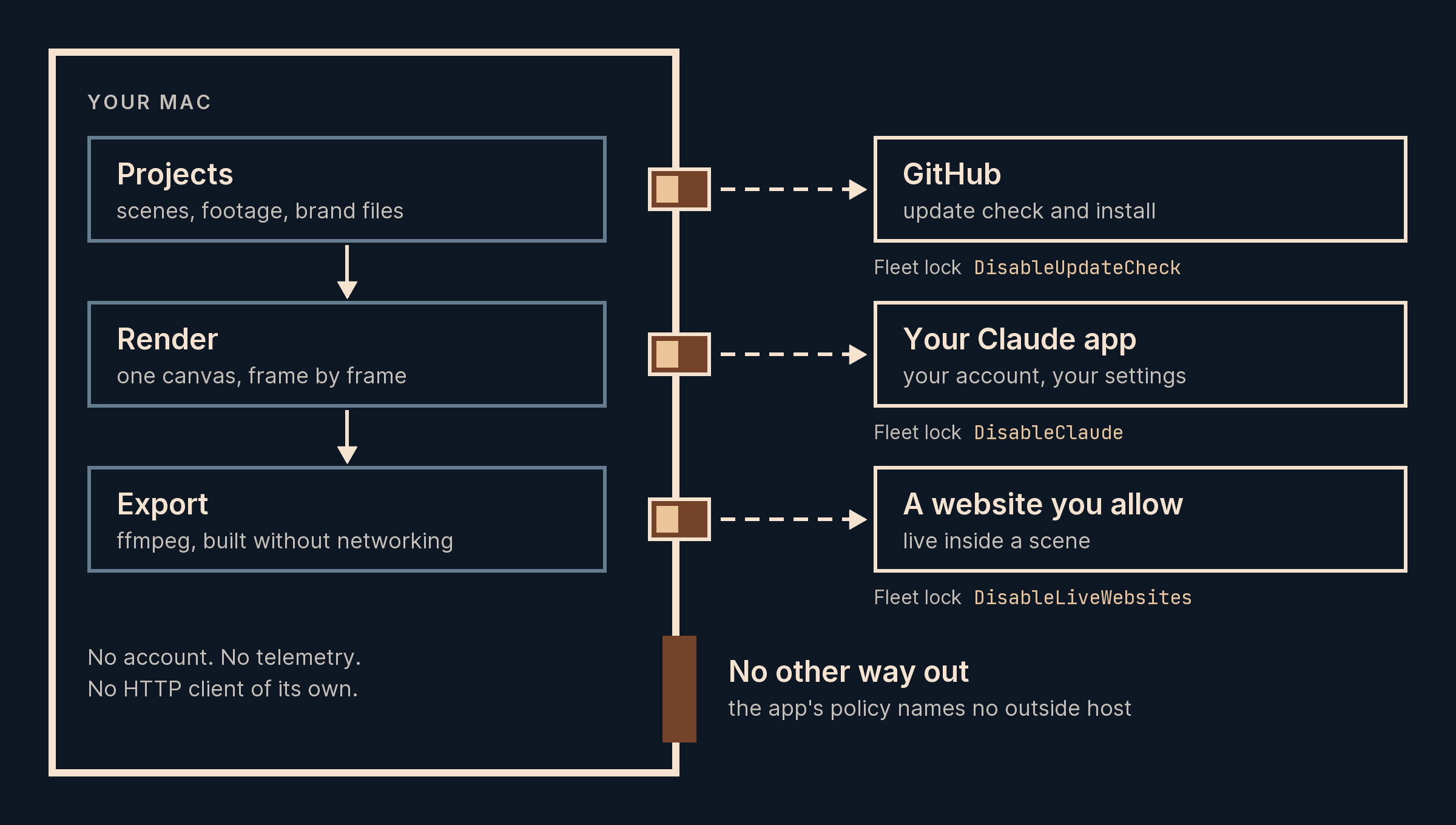
- There are no accounts, no telemetry and no crash reports. The app goes online for three things: updates, Edit with Claude and a website you allow in a scene. You turn each one on, and IT can turn each one off. What leaves the Mac
- The AI sees more than it should
- The app has no API key and sends nothing to Anthropic itself. Edit with Claude opens one project folder in your own Claude app, and nothing is sent until you press Enter there. Claude then sends that project's files to Anthropic, under your account and your organisation's Claude settings. What reaches your agent
- A project or pack you were sent runs code
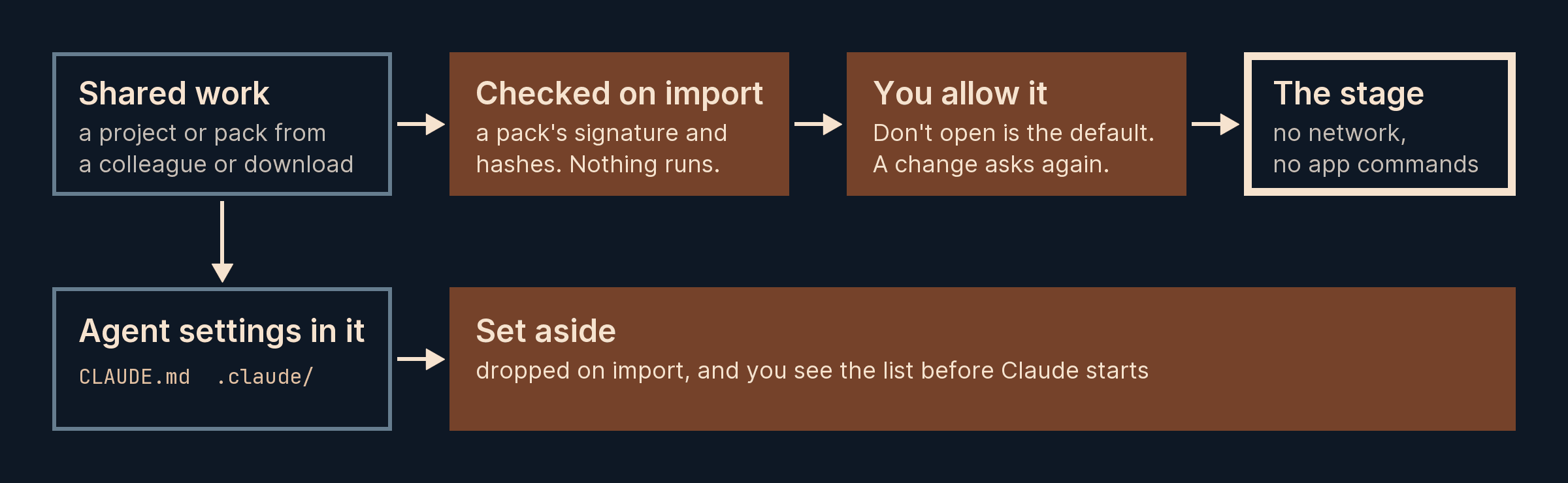
- Nothing runs when you import. Scene code runs only after you press Allow, and it can't reach the network or the app's commands. Packs are signed, and every file's hash is checked on import. Scene code and the trust boundary
- Text in a project tries to instruct the AI
- Text that Claude reads from a project is escaped, capped and marked as data. Agent settings in a shared folder are set aside, and you see the list before Claude starts. What reaches your agent
- A release or update is tampered with
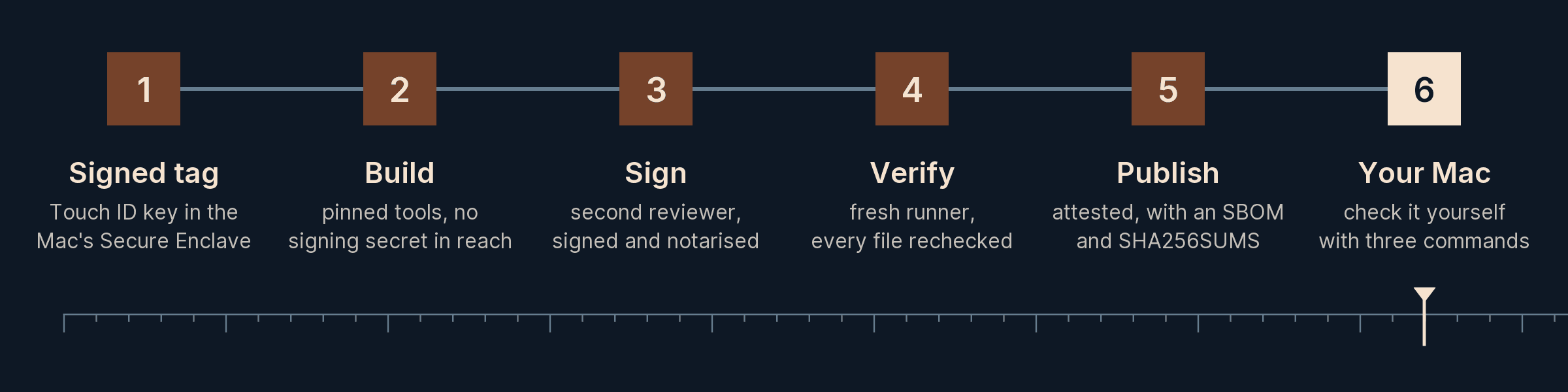
- GitHub Actions builds each release from a signed tag, with no signing secret in reach. Signing needs a second reviewer. Apple notarises the app, and each release comes with an attestation and an SBOM. An update installs only if it's signed with the key built into the app. Release integrity
- Confidential files sit on the Mac
- Projects stay in your home folder. Nothing is uploaded or synced. Only your account can read the app's data, and Spotlight skips it. The app adds no encryption of its own, so use FileVault. On the Mac
- Your organisation needs to set limits
- A configuration profile can lock eleven settings. People can't override them with defaults write. If a key is malformed, the app takes the safe option. Managed preferences
What leaves your Mac
Nothing, unless you choose. The app goes online for three things: the update check you agree to at first run, Edit with Claude, and a website you allow in a scene.
You can turn each one off, and IT can lock each one off with a configuration profile. Opening a project, importing a pack, exporting and presenting don't go online.
Source: SECURITY.md, What leaves the Mac
Not done yet
- One maintainer, who holds admin rights over the release rules.
- No third-party penetration test.
- No SOC 2, ISO 27001 or similar certification.
- No App Sandbox. The app runs under the hardened runtime with no entitlements.
- The AI is limited by rules and prompts, not by a sandbox.
Source: SECURITY.md, Not yet, the full list
How a release is built
Signing a release needs a second person's approval. Two reviewers are named, whoever starts the run cannot approve it, and admins cannot bypass the step.
The limit: one maintainer holds admin rights on the repository and can still change those rules, so the pipeline rests on one account. The one sanctioned exception is an urgent security fix while the other reviewer can't be reached. Self-review is then allowed for that run only, and it is named in that release's notes and advisory.
Source: SECURITY.md, Release integrity and the incident response plan
What each release carries
The 0.24.0 release page holds:
- The DMG, with the Developer ID signed and notarised app.
- A pkg for MDM installs, signed with a Developer ID Installer certificate and notarised.
- The zip, the updater archive and its
.sig, andlatest.json. SHA256SUMSandbuild-info.txt.- A CycloneDX SBOM,
KookaburraCut-0.24.0.cdx.json, attested on the DMG and the pkg. - The exact ffmpeg, x264 and x265 source archives the bundled ffmpeg was built from.
- The build provenance bundle,
KookaburraCut-0.24.0.intoto.jsonl. SECURITY.mdas it stood at the tag.
The commands that check a download are in the fleet guide, under Verify a release.
Source: SECURITY.md, Release integrity
Shared projects and packs
Nothing in a pack runs when you import it. Its signature and every file's hash are checked first.
Scene code runs only after you press Allow. The default button is Don't open. The code then runs with no network and no access to the app's commands. Agent settings in a shared folder are set aside, and you see the list before Claude starts.
Source: SECURITY.md, Scene code and the trust boundary and Packs
Managed Macs
A configuration profile from your MDM can force eleven keys in the domain com.mpalmes.kookaburracut. The app honours a key only while macOS reports it as forced, so a user's own defaults write grants nothing, and a malformed key fails closed.
DisableClaudeDisableAgentKitDisableLiveWebsitesAllowedWebsiteOriginsAllowedPublisherKeyIdsDisablePackExportDisableUpdateCheckUpdateEndpointExportsInProjectWorkspaceRootAuditLogPath
Two are new in 0.23.0: AuditLogPath keeps a copy of the app log in a folder your collector reads, and AllowedWebsiteOrigins lets live websites open only from the origins you list.
The pkg installs with no prompts through Jamf, Kandji, Mosyle or Intune. The deployment guide has a recipe for each, though none has run on a live tenant yet.
Source: Managed preferences, the fleet guide and the MDM deployment guide
Report a vulnerability
Report it privately, through GitHub's private vulnerability reporting or by email to security@kookaburracut.com. Please don't open a public issue for anything that looks like a security problem.
Include the app version (Settings ▸ About), your macOS version and steps to reproduce. You'll get an acknowledgement within 14 days, usually sooner, and a fix or mitigation plan once the report is confirmed.
Source: SECURITY.md, Reporting a vulnerability. The same contacts are in this site's security.txt.
Supported versions
0.23.0 is the first version recommended for managed Macs. Earlier versions are unsupported.
Only the latest release receives security fixes. Fixes are best effort, with no committed time.
Source: SECURITY.md, Supported versions
How fixes are disclosed
Every security fix is listed under Security in the changelog and in the release notes built from it. From 0.23.0 on, each fix also gets a GitHub security advisory. The fixes in 0.23.0 itself are listed in the changelog only.
To stay informed, watch the repository's releases (Watch ▸ Custom ▸ Releases) and its security advisories.
Source: SECURITY.md, Supported versions and the changelog at the tag
Licences inside the app
Every licence text and a third-party notices file ship inside the app, in Contents/Resources/licenses/. Settings ▸ About ▸ Acknowledgements shows them in Finder.
Source: SECURITY.md, Release integrity and the security overview, Questionnaire answers
This website
The kookaburracut.com web server keeps no access log for any request. It does not record your IP address, the pages you visit or your browser.
Only when the server fails to handle a request can its error log record the time, your IP address and the address you requested. That log stays on the server until the server software is next rebuilt, with no fixed deletion date.
Source: the privacy notice, section 6 and Subprocessors, The project's own services
The full record
Each document below is pinned to v0.24.0, the version this page describes.
- SECURITY.md
- Every control with the file or command behind it, and the threat model.
- SECURITY.md, Not yet
- What is deliberately not done yet, listed so nobody mistakes it for done.
- Security overview
- What leaves the Mac, where data rests, how releases are built and questionnaire answers.
- Privacy
- What can leave the Mac and what the app keeps, in plain words.
- Managed preferences
- Each key, its type, what it does when forced, and a sample profile.
- Fleet guide
- Verifying a release, which keys to force and what to expect in EDR.
- MDM deployment
- Install, profile, update and removal recipes for four MDMs.
- Changelog
- Every change, with security fixes under their own heading.